Dropping Odds
Selections whose price has shortened inside the last hour, six hours, or day — how the comparison is made and what a drop does and does not mean.
Open Dropping Odds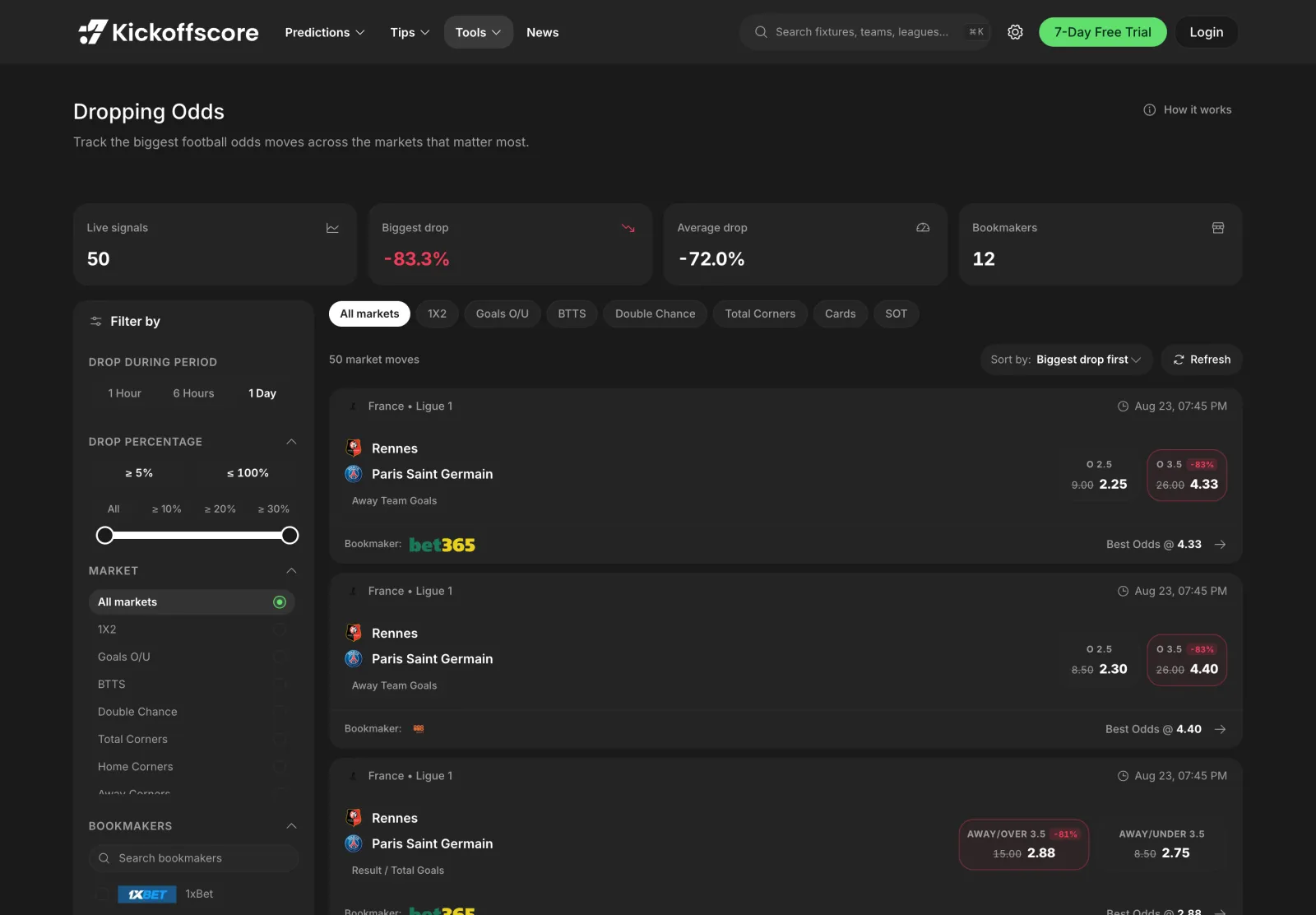
Dropping Odds tracks price movement. It compares the earliest and the latest captured price for a selection inside your chosen window and lists the selections that have shortened the most.
Windows and what they compare
Three windows are available: one hour, six hours, and twenty-four hours. Each compares the first and last snapshot captured inside it, so a longer window catches slow drift and a shorter one catches sudden moves.
Two snapshots are required
A selection needs at least two captured prices inside the window before a move can be calculated. Early in the day, an empty list usually means snapshots are still being collected rather than that nothing is moving.
The controls
- Market
- All markets, or one of 1X2, goals over/under, BTTS, double chance, total and team corners, cards, and shots on target.
- Drop percentage
- A slider with quick presets at 10, 20, and 30 percent, which filters out ordinary price noise.
- Window
- The comparison period: one hour, six hours, or one day.
- Bookmakers
- Restrict the comparison to specific bookmakers, with a searchable list.
- Sort
- Biggest drop first, or earliest kick-off first when you care about what is about to start.
Reading a card
Each card shows the drop percentage, the opening and current prices, how many snapshots were used, and when it last updated. The summary strip above the list carries the biggest drop, the number of live signals, the average drop, and how many bookmakers are represented.
A drop is information, not a tip
Prices shorten for many reasons: team news, weather, a large stake, or a bookmaker correcting an error. The move tells you the market has changed its mind. It does not tell you the market is right, and by the time a drop is visible some of the value has usually gone.
The most useful pattern is agreement: a selection the model already rates, priced above fair value, that is now shortening. That combination is stronger than either signal alone.
Related guides
- Value BetsSelections where the model probability exceeds the probability implied by the price, filtered so recent trends support the same market.
- Odds and valueThe arithmetic behind every tool on the site: converting a price into a probability, spotting the bookmaker margin, and knowing what an edge does and does not promise.
- Prediction AccuracyThe scoreboard for the model itself: accuracy by competition and market, monthly breakdowns, and tracked value-bet ROI and closing line value.